


Movie: Papam Prathap
Rating: 2.5/5
Banner: Win Original, Krishi Entertainments
Cast: Thiruveer, Payal Radhakrishna, Ajay Ghosh, Raasi, Devi Prasad, Goparaju Ramana, Ravi Anthony, Raghu Babu, Prasad Behra, Ananth Babu, Basha, Srinivas Avasarala and others
DOP: Vishweshwar S.V
Music Director: K.M. Radha Krishna
Background Score: Suresh Bobbili
Editor: Anwar Ali
Production Designer: Arvind Mule
Producers: Gaddam Rakesh Reddy, Rudradev Madhi Reddy
Written and Directed by: S.P. Durga Naresh
Release Date: April 17, 2026
Thiruveer has earned considerable appreciation for choosing content-rich films. However, this is the first time in his career that he has gone all out with promotions. He has also received strong support from the industry.
Let’s see whether he manages to win our hearts as Prathap this time.
Story:
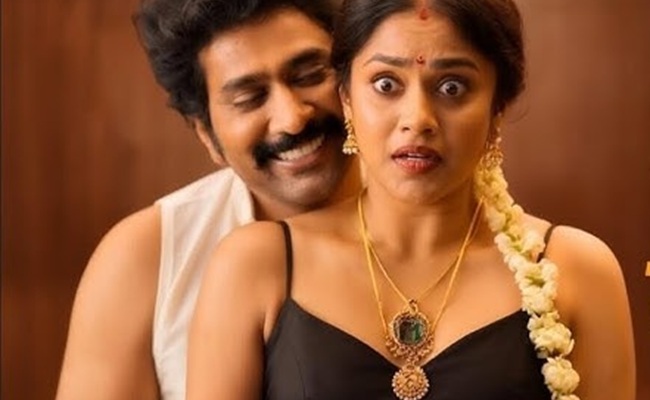
Set in the late 1990s, the film revolves around Prathap (Thiruveer), the son of a wealthy villager, who falls in love with Bujjamma (Payal Radhakrishna) and marries her. However, after spending just three nights together post-marriage, Bujjamma abruptly leaves him and returns to her maternal home.
She claims that Prathap has a problem, which leads her to take this drastic step. This sparks widespread speculation among the villagers about his manhood and personal life.
The rest of the film explores what Prathap actually does in his sleep that his wife cannot tolerate, how he discovers the truth, and whether he manages to overcome it and win her back.
Performances:
Thiruveer fits seamlessly into the role, portraying the innocence of a rural man from that era with natural ease.
Payal Radhakrishna is well-suited to her role and delivers a convincing performance, especially in a slightly bold sequence during a “reveal” sequence.
Among the supporting cast, Ajay Ghosh, playing Thiruveer’s father, tends to go overboard at times, with a repetitive acting style. Raashi makes a return after a long gap and plays the role of Thiruveer’s mother effectively.
Goparaju Ramana stands out in a unique role as a fan of Shakeela, adding a few light-hearted moments. Other actors like Prasad Behara, Raghu Babu, and Devi Prasad deliver decent performances.
Technical Aspects:
KM Radhakrishnan’s music is average, with no particularly memorable tracks. The cinematography is decent, especially considering the film’s low budget, with most scenes shot outdoors in a village setting. The production design is appropriate.
However, editing turns out to be the weakest link, as the film feels unnecessarily stretched. The dialogue writing also lacks impact.
Highlights:
Core story idea
Some fun moments
Thiruveer’s performance
Drawbacks:
Dragged-out narration
Lack of strong emotional depth
Old-school direction
Analysis
“Papam Prathap,” like most ETV Win productions, is set in a bygone era—typically the late 1990s or early 2000s. These films often revolve around relatively minor issues and simple situations, largely due to budget constraints. This film follows a similar template. However, it benefits from stronger casting, with several familiar faces in key roles.
The core idea of a man dealing with a problem that occurs during sleep is quite interesting and relatively unexplored in Telugu cinema. While the concept of a male protagonist suffering from a psychological issue limited to his sleep is novel, the narration lacks finesse.
The director initially succeeds in creating humorous situations, especially when the hero’s wife leaves him just three nights after their wedding. This leads to amusing speculation among villagers: ranging from doubts about his masculinity to assumptions about his sexuality.
Goparaju Ramana’s character, portrayed as a fan of Shakeela, adds to the humor. His desperation to watch her films in theatres and his overall lecherous behavior generate a few genuine laugh-out-loud moments.
The director smartly withholds the hero’s actual problem until the midpoint, keeping the screenplay engaging up to that stage. However, beyond that, the film struggles. The humor becomes inconsistent, and the portrayal of villagers turns overly exaggerated and, at times, outright silly.
Another major drawback is the film’s excessive runtime. Even after the central issue is revealed, the narrative continues to drag. Had the film been trimmed to around 2 hours or 2 hours 10 minutes, it would have had a much stronger impact. At 150 minutes, the film feels stretched, diluting its overall effectiveness.
Despite its promising premise, the screenplay and writing lack sharpness and freshness. More effort should have gone into crafting tighter and more engaging scenes.
Overall, “Papam Prathap” works in parts. While the core idea and a few humorous moments click, the lengthy runtime, old-school direction, and repetitive village panchayat sequences make it feel cliched. Ultimately, it suffers due to a lack of narrative sharpness.
Bottom line: Works in Parts