


Movie: Akhanda 2: Thaandavam
Rating: 2/5
Banner: 14 Reels Plus
Cast: Nandamuri Balakrishna, Samyuktha, Aadi Pinishetty, Harshaali Malhotra, Poorna, Kabir Duhan Singh, Saswata Chatterjee, Sangay Tsheltrim, and others
Music: Thaman S
DOP: C Ramprasad, Santoshh D Detakae
Production Designer: AS Prakash
Editor: Tammiraju
Action: Ram-Lakshaman, Ravi Varma
Producers: Raam Achanta, Gopi Achanta
Written and Direction: Boyapati Sreenu
Release Date: December 12, 2025
The biggest movie to close out 2025 has finally arrived after clearing financial and legal hurdles and a week’s postponement. Akhanda 2: Thaandavam, the much-awaited sequel to the blockbuster Akhanda, has been generating massive hype ever since it was announced.
Let’s see whether the film lives up to the towering expectations.
Story:
Set in the aftermath of the Galwan clash, a Chinese general (Sangay Tsheltrim) who seeks revenge for his son’s death and plans to destabilize India. He collaborates with a strategist (Saswata Chatterjee), who believes that the most effective way to weaken the nation is by breaking people’s faith. With the help of a corrupt local minister, they release a bio-virus into the Ganga during the Maha Kumbh Mela, causing widespread panic and a collective crisis of belief.
As the situation worsens, the Prime Minister learns that Janani (Harshaali Malhotra), a young DRDO scientist, has developed a vaccine. She is sent to Ladakh for mass production, but the Chinese general’s team launches a fierce attack.
Who will protect Janani and save the country? At this point, Akhanda (Nandamuri Balakrishna), now older but still powerful, steps in. The film follows how Akhanda rises again to confront the enemies, protect the nation, and restore faith in Sanatana Dharma.
Artistes’ Performances:
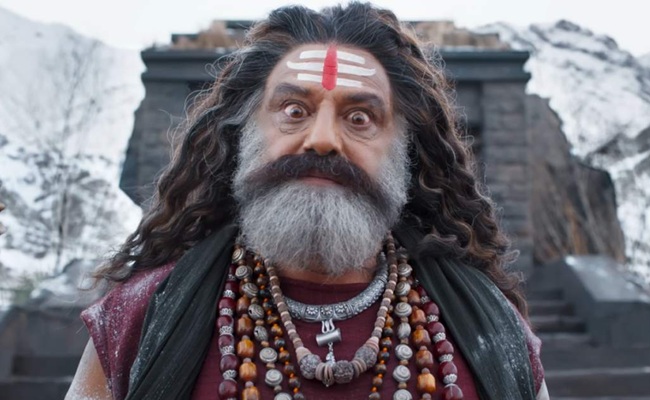
Nandamuri Balakrishna, who impressed audiences as Akhanda in the first film, returns to the same role in an aged avatar. In the original, the aghora characterization carried a strong impact and provided an element of surprise. In this sequel, that novelty is missing. Balakrishna appears in three shades — Balamurali Krishna, a younger aghora, and an older aghora — but only one of these versions is okay. His ferocity in action sequences and certain dialogue-heavy moments works, yet the overall performance and intensity do not match the original.
The film also suffers from weak antagonists. Both Aadhi Pinishetty and Sangay Tsheltrim are underutilized, with Aadhi receiving very little scope.
Samyuktha’s role adds no value, and her romantic track with Balakrishna comes across as awkward. Harshaali Malhotra, making her Telugu debut, is one of the few bright spots and delivers a convincing performance as a young scientist.
Technical Excellence:
Unlike the first Akhanda, this sequel does not offer any catchy songs. The “Jajikaya” track featuring Balakrishna and Samyuktha fails to make an impact on screen. Thaman not only misses the mark with the songs but also with the background score.
Despite relying on devotional hymns and high-decibel orchestration, the score feels loud without leaving the desired effect.
The cinematography is grand and the visuals appear rich, but the visual effects are subpar.
The dialogue writing follows the familiar Balayya–Boyapati template, with lines centered on Sanatana Dharma standing out. The editing, however, lacks finesse.
Highlights:
Pre-interval bang
Sanathana Dharma dialogue episode
Drawback:
The dull first half
Weak story and flat narration
The bland mix of devotion and patriotism
Weak villains
Thaman’s dull music
Analysis
Nandamuri Balakrishna and director Boyapati Sreenu are known as a successful combination. Their earlier films followed a familiar pattern: a ruthless villain, a younger Balakrishna handling romance and action, a major crisis before the interval, the entry of an elder Balakrishna, an extended flashback, and finally the younger Balakrishna defeating the antagonist.
Akhanda added some freshness to this formula by introducing a strong devotional angle and the Aghora avatar, which resonated with audiences. It ended with the Aghora promising to return whenever dharma needed him, naturally paving the way for a sequel.
Akhanda 2 takes that cue and attempts to amplify the scale. Instead of local conflicts, Boyapati shifts to themes of Chinese aggression, biowarfare, and the protection of Sanatana Dharma. The film tries to blend foreign terrorism, attacks on Hindus, mother sentiment, child sentiment, and heavy devotion, mixing all of them into one dense narrative.
In doing so, the film seems to borrow elements from recent devotional hits like “Mahavatar Narasimha” and “Hanu-Man.” There is a forced animated appearance of Lakshmi Narasimha, a sequence involving Lord Hanuman fighting Aadhi Pinishetty’s character, and an episode with Lord Shiva. Devotion, patriotism, mythological references, or multiple roles can work well when they emerge organically, but here the hyper-commercialized treatment and exaggerated execution weaken the narrative.
The biggest shortcomings of “Akhanda 2” are its ineffective screenplay and lack of strong villains. Boyapati replaces the typical factionist or mining baron antagonist with the Chinese army, but even this shift fails to evoke patriotism.
In the entire first half, Balakrishna appears in only three episodes: the Aghora entering the Himalayas, Balamurali Krishna showing up briefly and performing the “Jajikaya” song with Samyuktha, and the Aghora reappearing at the interval. Boyapati seems aware that the “Jajikaya” song is ineffective, so he inserts the “Jai Balayya” track from the original and even adds a shirt-drop dance bit to compensate.
The second half features several action blocks and dialogues about Sanatana Dharma, yet even dramatic divine appearances lack emotional impact due to forced staging and weak performances. The film is also filled with illogical situations. From the Prime Minister to the Army Chief, everyone is reduced to a spectator while a lone Aghora is portrayed as the nation’s only savior. The inclusion of Boyapati’s son as Prahlada adds nothing meaningful.
Even in the action sequences, Balakrishna hardly fights; his trident (Trishoolam) performs most of the combat. In one scene, more than a dozen villains fire machine guns at him, and the trident blocks every bullet. Logic is abandoned completely.
If the vaccine is crucial for national safety, the government failing to provide adequate protection to the scientist is baffling. One team being wiped out should not halt the entire machinery. The idea of the Chinese army attempting to blow up Kailasa Parvata further stretches credibility.
By the time the film ends, the only relief is that it does not hint at a third installment.
Overall, “Akhanda 2” falters on almost every front. The film once again proves that when makers rely solely on brand value and the success of the first part without a solid story, the result is an illogical product. Weak narration is its biggest drawback. Despite a few devotional elements, the entire drama misfires. Boyapati’s films may not run on logic, but this one fails even to deliver mass-appeal moments.
Bottom-line: Disappointment