


A panel of leading American strategic experts has cautioned that the United States and India are navigating one of the most fragile phases in their relationship in nearly a quarter century, with political mistrust, stalled trade talks and geopolitical pressures testing what has long been seen in Washington as a critical partnership in the Indo-Pacific.
For the last 25 years, there has been a concerted effort among both parties in the United States and governments of different kinds in India to transform the US-India relationship, as observed by Richard Fontaine at the Centre for a New American Security (CNAS), in a discussion here in the American Capital on Wednesday (local time).
That effort, he said, was widely viewed as "one key to responding to China and to the challenges of security in the Indo-Pacific."
"But we're in a different place now," Fontaine said, pointing to an ongoing trade dispute, hardening rhetoric and the view among some in Washington that relations "are in the lowest point in the past 25 years."
'Worst shape in almost 25 years'
Lisa Curtis, Senior Fellow and Director of the Indo-Pacific Security Program at CNAS and a former senior official in the first Trump administration, delivered the starkest assessment. "The US-India relationship is probably in the worst shape it's been in in almost 25 years," she said.
Curtis argued that "this point feels worse." Expectations had been high, she said, "that President Trump would be good for the US-India relationship," given the elevation of ties during his first term.
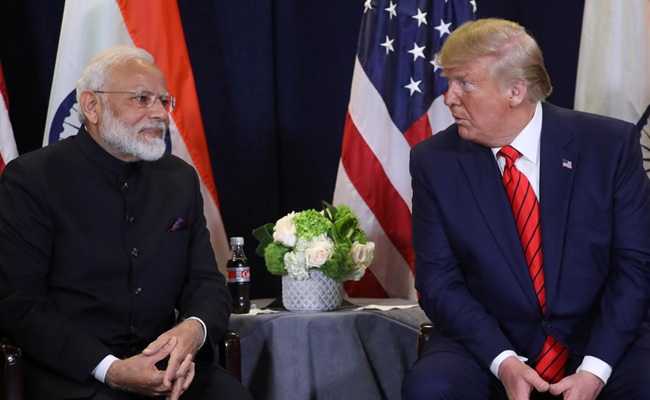
She pointed to Trump's February 2020 visit to India, the 'Howdy Modi' event in 2019, and the US support during India's border crisis with China as moments when relations were "at an all-time high."
Instead, she said, sharp tariff hikes, "degrading and insulting social media posts" by senior officials, and the invitation extended to Pakistan Army Chief Gen. Asim Munir to the Oval Office, just weeks after a major terrorist attack in Jammu and Kashmir, India, signalled a dramatic downturn. "It really is disappointing to see how far this relationship has deteriorated," Curtis said.
Curtis warned that Prime Minister Narendra Modi's hosting of President Vladimir Putin this week would be viewed in Washington as "bad timing" but "not so surprising" given US pressure on India. "India values its strategic autonomy," she said, adding that Delhi was "demonstrating it's not going to be bullied by the United States."
'Nothing easy or natural' about the partnership
Lindsey Ford, Senior Fellow at the Observer Research Foundation America and former Senior Director for South Asia at the White House, agreed with the diagnosis and said the downturn reflected the absence of political champions on both sides.
"There is nothing easy or natural about how we got to where we are," she said, rejecting the long-used phrase "natural allies." The partnership, she argued, "has taken high-level champions in both governments," and at present", it's unclear who the high-level champions are" in Washington or New Delhi.
Ford said the logic for rebuilding trust remains compelling. "If you believe that the rise of China presents a generational challenge to US security and prosperity… a closer US-India relationship is essential," she said.
A stable balance of power in the Indo-Pacific, she added, is impossible "if you do not have a strong India that is more aligned with the United States."
India's diversification and the Russia question
Tanvi Madan, Senior Fellow at the Brookings Institution, stressed that India's current outreach to Russia and China fits within its long-standing diversification strategy rather than signalling a major realignment.
India, she said, seeks "security, prosperity, status, but also autonomy," maintaining a "diversified portfolio of partners" across the West, Asia and Eurasia.
She argued that the Putin visit must be viewed in context. Indian engagement with Japan, Australia, South Korea and Europe has been "far more substantive," she said, and India's trade imbalance with Russia -- now second only to China -- explains Delhi's push for Moscow to buy more Indian goods. "There are real limits to the Russia-India relationship," she added, citing Moscow's ties with Pakistan and China.
Madan noted that despite political friction, "functional cooperation is continuing," including defence exercises and technology engagements. The moment, she said, highlights both "how fragile the relationship is" and "how resilient it still is."