


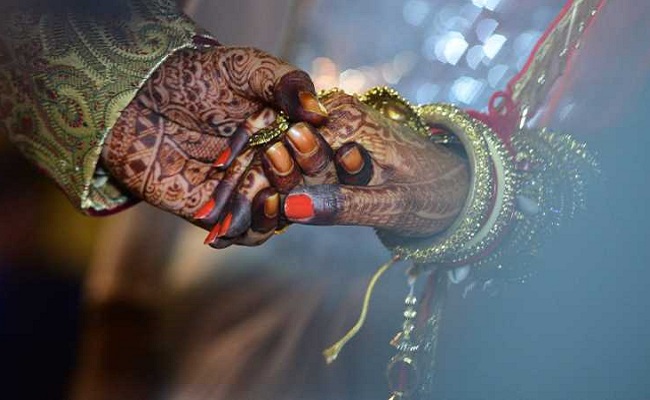
It is well known that love marriages often happen outside the caste system, and that has been the case for a long time.
However, arranged marriages traditionally take place with the mutual consent of families on both sides, and caste has usually played a vital role.
While elite and affluent families broke this barrier long ago, the trend is now slowly spreading to middle class and upper middle class families as well.
“We belong to the Kamma community and my cousin’s wife belongs to the Reddy community. Theirs is an arranged marriage, and the bride and groom did not know each other until the proposal came through common friends", said Swaroopa Adusumilli of Vijayawada, sharing her personal experience.
She continued, "The main reason both agreed was that they liked each other, and their family backgrounds, food habits, and inclination toward religion were similar".
"Moreover, both come from the same district, which added familiarity. The common friends were also connected to both families for decades, so they united through marriage,” she concluded.
There are many such instances. One was shared by an elderly man from the Brahmin community.
Satyanarayana Murthy, a retired lecturer shared, “In our generation, Brahmins would not marry even outside their sect. Niyogis, Vaidikis, Sreevaishnavas, Dravidas, or other Brahmin sects usually married within their own groups. But for the past 25 years, the sect barrier has been fading. As long as the match is from the Brahmin community with a good family background and a stable job, marriages have been happening".
He also mentioned, "However, in the last four to five years, I have noticed arranged marriages taking place even when the other family belongs to a different caste, as long as they are strict vegetarians and respect religious traditions. It has become more about matching wavelengths and shared lifestyle. Even Vysya families are merging with Brahmin families. I know a Velama family who are followers of Chinna Jeeyar Swamy, very religious and strict vegetarians, who married their daughter to a boy from a Brahmin family known to us,” he said.
Another interesting aspect was shared by a person from the Raju community.
“I must confess that I felt bad when my daughter loved a boy from another community. Both of them wanted their union to happen through an arranged marriage. I felt that my grand children would not belong to my caste. Of course, I never expressed this feeling to anyone. However, before the marriage itself, the couple had decided not to have children. They shared this with me after the wedding. They said they wanted to lead a DINK life, which means Dual Income No Kids. It is their life and their choice. Even if I had married my daughter within the same caste, she might still have chosen someone who agreed with her DINK decision,” he shared.
“Caste has little importance when people outgrow such boundaries. What matters more is the mutual wavelength between two families and their long-standing friendships. I know many friends who arranged marriages between their children and the children of close friends, even though their castes were different,” said Avinash Kumar, an NRI from Houston.
However, while marriages are evolving in this way, divorce rates are also rising at an alarming pace.
This trend is visible not only in inter caste arranged marriages but also in same caste arranged marriages and love marriages.
Compatibility issues and financial independence are playing a significant role in shaping the stability of modern marriages.