


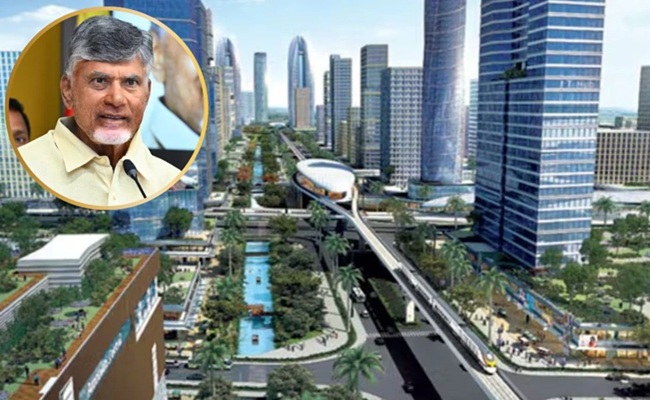
Chief Minister Chandrababu Naidu has brought a resolution in the Assembly to recognize Amaravati as the permanent capital of Andhra Pradesh.
The TDP brigade is stating that it is historical and that it will clear all uncertainties and boost development without any doubt.
But what are the uncertainties they are referring to?
According to the TDP, investors are hesitant to come forward because they fear the possible return of Y S Jagan Mohan Reddy as Chief Minister, whom they believe is not supportive of Amaravati’s development.
The party argues that passing this resolution in the Assembly will address those concerns and reassure investors.
Similarly, farmers have been reluctant to offer land for the second phase of Amaravati’s development, for which Chandrababu Naidu has set a target of 50,000 acres.
The TDP attributes this hesitation to the same concern about Jagan Mohan Reddy’s potential return to power, and believes that the Assembly resolution will encourage farmers to come forward and contribute their land for the capital’s expansion.
If this works out, the TDP supremo believes Amaravati would witness a sharp rise in real estate activity, setting the stage for rapid growth.
But what is the actual situation?
Chandrababu Naidu, Lokesh, and others in the TDP should understand that Amaravati’s lack of traction cannot be attributed solely to Y S Jagan Mohan Reddy. That is a relatively minor issue and an unnecessary fear.
Jagan himself never said Amaravati would not be a capital; he only stated that it would at least remain the legislative capital. Therefore, whatever development the region can sustain will take place regardless of who is in power.
Ultimately, the extent of development a place achieves is determined by people and broader realities, not by political leaders alone.
For instance, the world has seen how Amaravati got inundated with huge flood waters amid proposals and projections to make it a world class capital.
How much would it cost for the government to make the region flood free with proper flood water management structures? That itself runs into thousands of crores and consumes long time.
Apart from that, building a capital city with the widest roads and international standard infrastructure before 2029 is tantamount to building castles in the air.
I would agree and applaud the TDP coalition government if it can build a wide road and strong connectivity to Visakhapatnam city from Bhogapuram Airport before the 2029 election.
That is a reasonable thing they can do if the intention is strong. But building Amaravati as projected is unrealistic.
Amaravati has several limitations that people have gradually come to recognize. The city largely exists on paper and appears to be driven more by policy push than by natural and organic public support.
For a capital city to truly take shape, it is not enough to attract investors or secure land from farmers. The broader public must also be willing to settle there by buying land and building homes.
A place must offer certain natural advantages to encourage such migration, such as scenic surroundings, pleasant climate and weather conditions, and an overall appealing living environment.
Compared to Visakhapatnam, Amaravati does not offer many of these natural attractions.
Visakhapatnam has never been the capital city of Andhra Pradesh, yet it developed naturally. The natural harbor made it a base for the Indian Navy.
The scenic mountains and hills, the attractive coastline of RK Beach, and the ups and downs within the city are natural attractions for people to live there.
Yet even its development, when compared to Hyderabad or Bengaluru, is relatively slow and nowhere close. That is the natural and organic pace of growth for that place.
Hyderabad and Bengaluru grew well first because of their climatic conditions. Both cities are relatively less humid, attracting more settlements compared to coastal towns and cities.
During the first phase of Amaravati development, people came forward assuming that what Chandrababu Naidu was saying was real and achievable.
But within those five years between 2014 and 2019, time was spent largely on pooling of land, graphics, proposals, meetings and perception building.
Eventually, between 2019 and 2024, the YSRCP government killed most expectations in that region, which is also true.
Though the present government is trying to point out YSRCP for hindering the growth of Amaravati, the truth is that people have understood the reality that Amaravati cannot grow as initially assumed.
As the saying goes, no one can stop the light of a rising sun. Likewise, if Amaravati truly has the potential to grow, no one can hold it back.
The TDP should recognize that no Y S Jagan Mohan Reddy can obstruct the growth of a city if people genuinely support it, just as no Chandrababu Naidu can force such growth if the place does not naturally command it.