


Film: Dhandoraa
Rating: 2.5/5
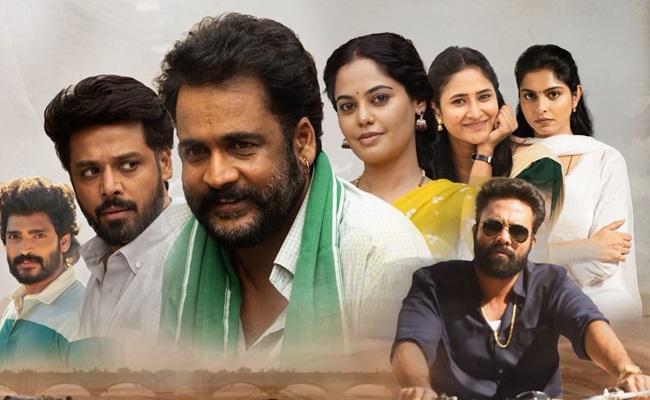
Cast: Shivaji, Shree Nandu, Mounika Reddy, Aditi Bhavaraju, Ravi Krishna Thota, Bindu Madhavi, Navadeep, Raadhya Suresh, Muralidhar Goud, etc.
Music: Mark K. Robin
Editor: Srujana Adusumilli
Producer: Ravindra Banerjee
Director: Murali Kanth Devasoth
Release Date: 25 December 2025
This film gained traction through publicity, with expectations rising after the success of The Court, which addressed a similar theme of casteism in society.
Naturally, curiosity surrounds this release, prompting audiences to see how effectively it handles the subject, presents its narrative, and delivers a meaningful cinematic experience overall today.
Story:
Vishnu (Nandu), a GHMC employee, lives in Hyderabad with his wife Vinita (Mounika Reddy) and daughter Swetha. He receives a call informing him that his father Shivaji (Shivaji) has died in his sleep in their village. Though not very emotional, he travels with his family to attend the funeral.
The film then moves into flashbacks, where Shivaji is portrayed as a rigid upper-caste fanatic. He also has a daughter, Sujatha, who is in love with Ravi (Ravi Krishna Thota), a Scheduled Caste man. Enraged, Shivaji warns Ravi and physically abuses his daughter. Later, Shivaji’s upper-caste friends attack Ravi.
What follows forms the rest of the story, which explores human relationships in a village deeply affected by casteism.
Artistes’ Performances:
Shivaji performs well, and his role resembles an extended version of his Mangapathi character from The Court. However, here he is less loud and more restrained, portraying a typical caste fanatic.
Shree Nandu delivers a convincing performance as the dejected son of a casteist father, with emotions handled subtly.
Ravi Krishna Thota, as Ravi, effectively portrays a man facing caste discrimination.
Navadeep entertains with his subtle histrionics and dialogues, and his character has a strong narrative thread.
Singer Aditi Bhavaraju appears as Shree Nandu’s ex-lover and makes a brief yet impactful appearance.
The actress playing Sujatha performs well, with ample screen presence and scope.
Raadhya Suresh plays an important role, revealed towards the end.
Bindu Madhavi portrays a sex worker in a mature, meaningful role.
Muralidhar Goud appears in a short but effective role, leaving an impression with his natural performance.
Technical Excellence:
The music is effective, with lyrics by Kasarla Shyam sounding clear and subtle. The songs “Dandoraa…” and “Parichayamavakundaa…” are situationally impressive, though the latter has a vintage feel.
The cinematography is good, enhancing the rural mood, while the screenplay remains engaging throughout. However, the editing could have been sharper to improve the film’s overall pacing and impact.
Highlights:
Subtle, mature narrative
Self Reform approach
Thoughtful and subtle storytelling
Drawbacks:
Lacks a youthful vibe
Feels lengthy despite not being dragged
Analysis:
The highlight of this film is that there is no hero-like protagonist. Every character behaves according to their emotions and does not stand out as a role model. The characters learn from their failures and amend themselves, which is a mature narrative approach rarely seen in today’s films.
The director deserves accolades for making a film that feels like a story from a mature novel of the 1970s. However, to make the film commercially viable in theatres, especially while dealing with caste, the love story should have dominated the political and other human emotions.
Films like The Court, Uppena, and Dhadak worked because younger audiences connected strongly with the love angle. Here, since the love story remains in the backdrop and does not dominate the film’s mood, it misses an opportunity to hook younger, theatre-going audiences. Except for this limitation, the film is well made overall.
Though such stories may feel like TV serial material these days, the way the screenplay is handled makes all the difference. The film feels lengthy due to its steady, composed narrative that takes time for every scene. Even though the total duration is not excessive, it appears long because of the detailed storytelling.
The first half is gripping, while the second half feels lengthy, though not dragging. At times, it feels like the film is taking too long to reach an end, as there is no strong climax point. However, eventually, everything concludes in a mature manner.
Overall, this film is meant for a mature audience that appreciates human emotions, relationships, and the negative effects of caste fanaticism. A scene where Shivaji confesses in court resembles a moment from Temper, but here it is handled subtly and fits the situation perfectly. An interesting aspect is that the director avoids naming specific castes, choosing instead to show differences to generalize the subject and avoid censor issues. Still, the word “Karamchedu” is blurred in one scene, hinting at censorship concerns, though it remains visible.
The film neither bluntly attacks upper castes nor directly condemns discrimination but addresses the issue thoughtfully, subtly questioning societal behavior and advocating reform.
Bottom Line: Matured narrative