


 Epaper




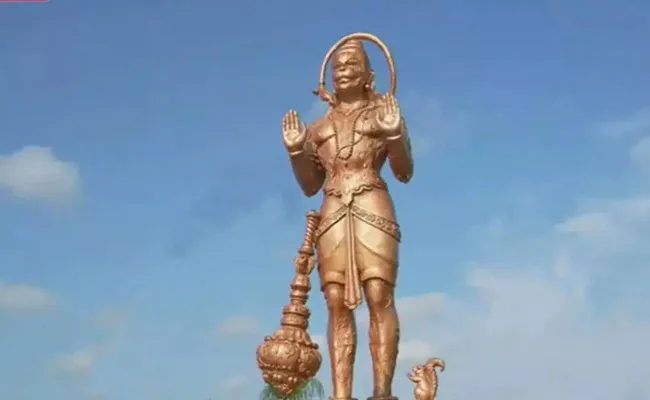
Everything is supposed to be bigger in Texas. But a 90-foot statue of Hanuman outside Houston has become the centre of a much bigger argument over religion, immigration and identity in the state.
The Statue of Union, installed at the Sri Ashtalakshmi Temple in the Sugar Land area, was unveiled in August 2024 after a three-day consecration ceremony.
The 90-foot monument is dedicated to Hanuman and was conceived as a symbol of strength, devotion and unity. Temple officials say the name reflects Hanuman’s role in reuniting Rama and Sita in the Ramayana.
The statue has also attracted attention for its sheer scale. It is widely described as one of the tallest statues in the United States and the tallest Hanuman statue in North America.
Soon after its unveiling, however, the monument became controversial.
In August 2024, members of a local Christian congregation gathered near the temple, prayed around the statue and described it as representing a “false idol.”
Temple officials said some visitors felt intimidated by the group’s preaching, although the church leader maintained that the gathering was intended as peaceful prayer rather than a protest.
Since then, the debate has moved well beyond theology.
The statue has increasingly featured in broader arguments in Texas over immigration, cultural change and the growing visibility of Indian Americans, particularly in the Houston and Dallas regions.
Earlier this year, conservative activist Carlos Turcios posted a video featuring the statue and used anti-immigration language, including the phrase “third world aliens,” while questioning its presence in Texas.
More recently, conservative commentator Kaylee Campbell drew criticism after asking on social media how Texas could be taken seriously with a 90-foot “monkey god” statue.
Her remarks prompted responses from Hindu advocacy groups and commentators defending religious pluralism and the right of Hindu Americans to publicly express their faith.
Temple leaders reject the suggestion that the monument represents an attempt to transform Texas culturally or politically. They describe it instead as an expression of faith by a community that considers itself part of the state.
Temple representatives have also said the project followed the required permitting process.
The structure was engineered to withstand winds exceeding 180 mph, reflecting the hurricane risks of the Houston region. The statue was assembled after components were transported to Texas, and the project was funded through donations.
The monument was envisioned by Sri Chinna Jeeyar Swami, who also conceived Hyderabad’s Statue of Equality. His organisation describes Hanuman as a symbol of selfless service and unity.
Hanuman devotion in the United States, however, predates the Texas statue by decades.
Temples and ashrams connected to Hanuman worship have existed in several parts of the country, including California, New Mexico and Texas itself.
Hanuman has also appeared in an unexpected corner of American presidential history.
Barack Obama revealed in 2016 that he sometimes carried a small Hanuman figurine among several personal keepsakes.
The Barack Obama Presidential Library collection maintained by the National Archives includes a small metal Hanuman figure given to him by a member of the public.
The wider debate comes as Texas politicians send contrasting messages about the state’s growing Indian-American population.
Governor Greg Abbott has actively courted Indian-American communities, including hosting Diwali celebrations and promoting economic ties with India.
At a 2024 Diwali event, he said Texas would remain “a land for the Indian community.” At the same time, parts of the state’s conservative political ecosystem have seen increasingly sharp rhetoric about immigration and Indian professionals.
That contradiction has helped turn what began as a religious monument into a symbol in a much broader cultural debate.
For supporters, the Statue of Union represents the visibility of Hindu Americans within a pluralistic society. For critics, it has become part of arguments over immigration, assimilation and religious identity.
What is clear is that the statue is no longer simply a 90-foot figure overlooking a temple complex.
It has become part of Texas’ continuing argument over who belongs, how immigrant communities express themselves and how religious diversity fits into the state’s changing identity.


What is the need for such in the first place? Jester has no other work than spending lavishly. What purpose even the unity statue in Hyderabad serving?
100% agreed
The Desi Sara Gonzales formula goes loke this…
Real Sara goes after tech workers in Frisco parking lots for her Texas rage-vlogs, and desi Sara hunts down suburban statues to write end-of-days clickbait for gullible NRIs. Same grift, same outrage-farming, just a different language.
Why cannot you keep your prayers and beliefs to yourselves especially when you are in a different country?? mindless people
Religon is a birus. In hindia maipoor, in other countries it takes a different form. Ideology is the same, there are stapid ppl in every country. Appreciate who gave permit to have one like that.
Is it necessary? No. Is it legal? Yes. There ends the debate.
Is your birth necessary ? No. Are you born? Yes, Is it legal? here starts the debate!
Assimilation doesn’t mean converting to the local religion. Whoever said or believes that is an idiot.
Some Indians, both in India and abroad, seem increasingly fascinated with erecting massive statues and monuments. I respect religious freedom and preserving our culture, but does everything need to become bigger, taller, and more visible? My cousin, who has lived in Sugar Land for about 20 years, and my doctor uncle, who has lived in the U.S. since the 1970s, have personally expressed concerns about this trend and the attention it can sometimes attract. Earlier Indian immigrants played an important role in establishing temples and cultural organizations to help future generations stay connected to their heritage. At the same time, some may now wonder whether increasingly elaborate public displays are always necessary. Now, they are having issues when they go out. They have to show ID. The same question applies to erecting statues of personalities such as Sr. NTR in America. What purpose does it serve here? The Dot busters violence against Indians in New Jersey during the 1980s also reminds us that anti-Indian hostility existed long before today’s political climate. Responsibility for such hatred and violence belongs entirely to those who commit it. At the same time, immigrant communities can value cultural pride while also being thoughtful about integration and relations with the broader community. Preserving our culture doesn’t require competing to build the biggest statue or monument. Religious freedom, cultural pride, restraint, and community awareness can coexist.
I think it is a statement telling Hinduism has arrived.
Hanuman is Vanara not monkey god as portrayed by foreigners.
To me, in Ramayana, Rama is the God and Hanuman is not even a side kick.
From 90’s onwards , we saw this Hanuman trend in AP.
☪️✝️: Hinduism is fake.
🕉: All religions are equal. 🤡
Empty vessels make noise. Not much to show off to Americans as we immigrated from an average developing country with filth at every street corner. How else you can make Americans feel bad for their limited history in North America? Import ancient culture to a modern society and demonstrate that we were better. Sounds like a brilliant idea or maybe not.